What business coaching communities are quietly building, and where it breaks
Business coaching communities keep bolting AI assistants onto Slack. It works, but it hits three limits fast, so I built a standalone version to see what changes.
I keep noticing the same pattern in business coaching communities. Nobody set out to build an AI product, they just kept bolting assistants onto Slack until the whole thing was quietly running on chat. Someone asks a question, an assistant answers, everyone moves on. It works, and it's genuinely useful.
It also runs into three limits pretty fast. It lives inside the chat tool, so only people already in the workspace can use it, there's nowhere to send someone who's just curious. It runs on live LLM calls, so every conversation costs money and the bill grows with every new user. And when someone tries to make a free version available more widely, it usually ends up as a custom GPT sitting on somebody else's platform, instead of an actual product with its own front door.
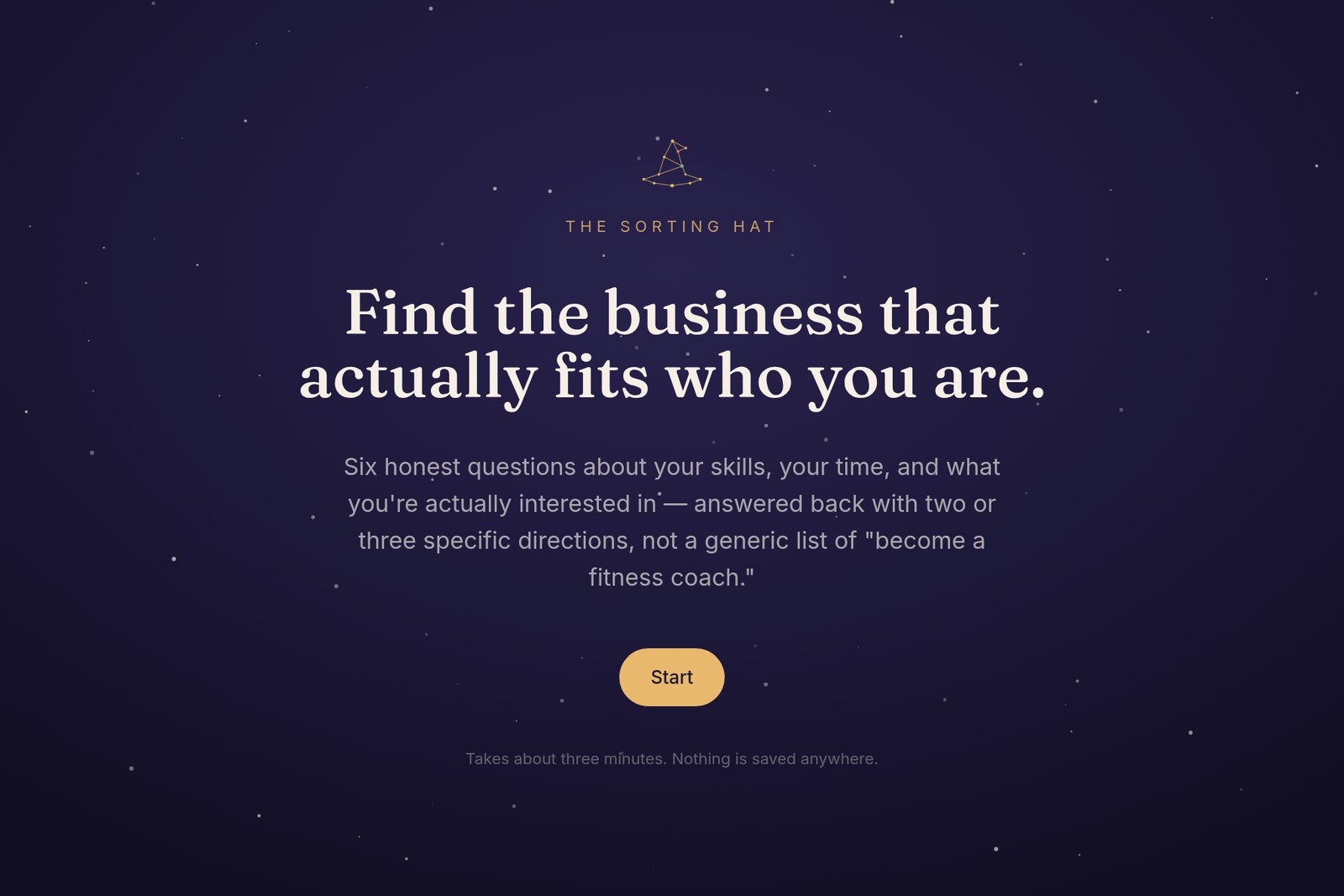
So I built one outside the chat, to see what it'd look like as a real standalone tool. That's The Sorting Hat: six honest questions about skills, time, interests, and what's actually holding you back, and it returns two or three specific business directions instead of a generic list.
The interesting part wasn't the questions, it was making the economics work. A free tool that might reach a large audience can't let its cost scale with every visitor, so the recommendation engine is rules-based. It scores your answers against a set of niche templates and fills them in with your own words. Most of what makes a result feel personal costs nothing to compute. An LLM only earns its place in one spot, turning free-text answers into natural sentences, and that's one bounded, cacheable call per session. If the model's down or rate-limited, the rules engine still returns a complete result on its own.
No backend either. It runs entirely client-side, so it deploys as a static site with no database, no auth, and nothing to keep running.
It's a demonstration, not a production system, the goal was to show that a tool like this can stand on its own, and work out where the money would and wouldn't go if it did.
Full technical breakdown is in the case study. Live demo's here, code's on GitHub.